
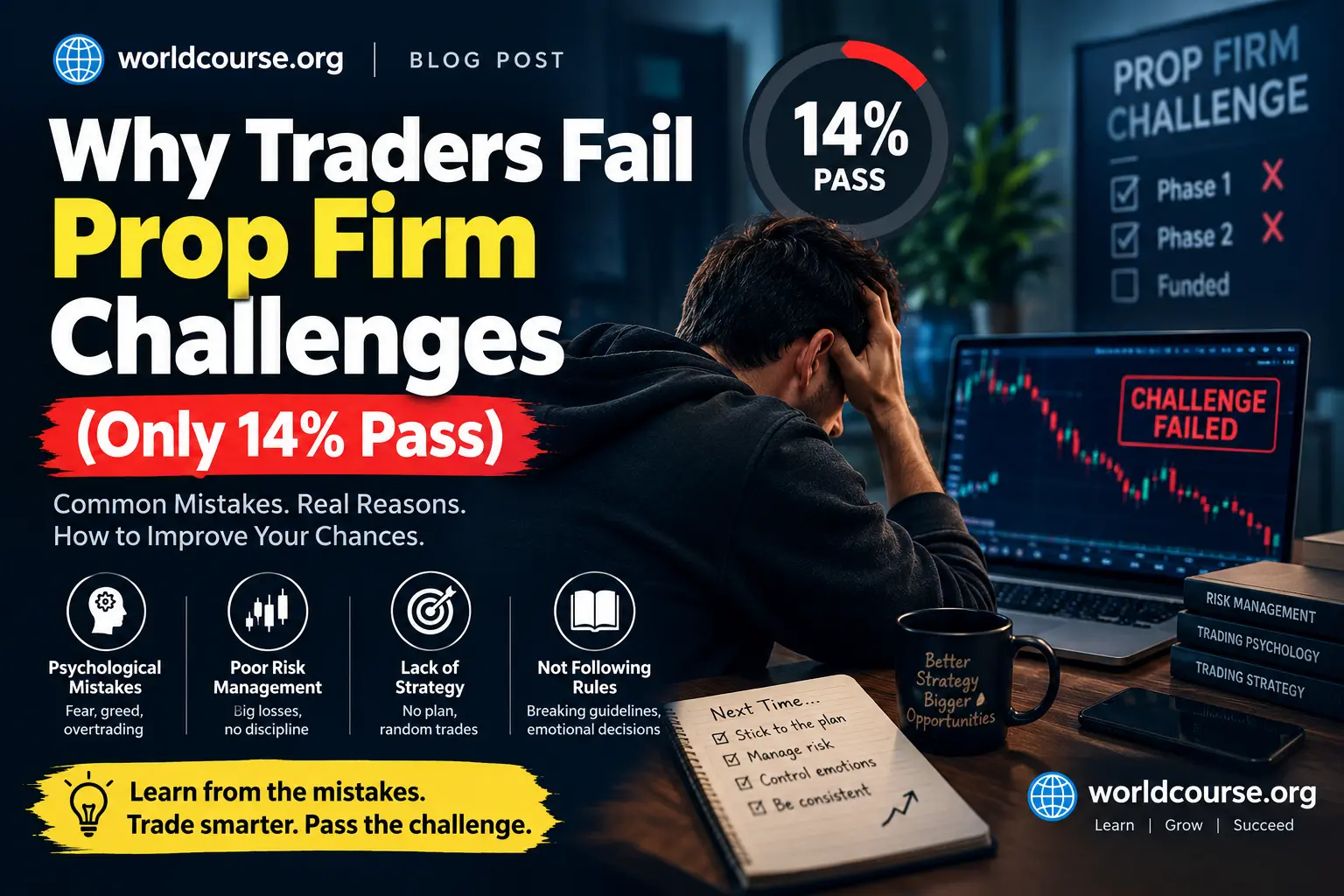
Search interest in prop firm challenges has exploded over the past few years, industry data shows global search volume climbing more than fiftyfold since 2020. But behind that surging interest sits an uncomfortable number: across large datasets tracking hundreds of thousands of funded accounts, only around 14% of traders actually pass their evaluation on the first attempt. Why traders fail prop firm challenges this often isn’t about talent, it’s almost entirely about a handful of specific, repeated mistakes.
What Is a Prop Firm, and Why Does the Challenge Exist?
What is a prop firm, in simple terms? A proprietary trading firm provides capital to traders in exchange for a share of the profits, rather than requiring traders to risk their own money. Proprietary trading firms use a challenge specifically as a filtering mechanism, a low-cost way to evaluate thousands of applicants and only allocate real funded accounts to the ones who demonstrate they can trade within a strict risk framework. Understanding this purpose reframes the whole evaluation: it’s not designed purely to test profitability, it’s designed to test rule discipline under pressure.
The Real Pass Rate Data
Independent analysis of prop firm outcomes, drawing on data from tens of thousands of trader accounts across multiple firms, consistently lands in a similar range: roughly 14% of challenge attempts succeed, though this varies by firm, with some reporting first-attempt pass rates closer to 15-20% and others below 5%. Of the traders who do pass and get funded, further data suggests fewer than half go on to actually receive a payout, meaning the real “success rate” from start to a funded account trading real payouts is smaller still. Some firms have started offering instant funding options that skip the evaluation entirely for a higher upfront fee, though these typically come with their own tighter risk parameters once trading begins.
This isn’t meant to discourage anyone from attempting a challenge. It’s meant to reframe the question. If the pass rate were driven primarily by trading skill, you’d expect it to track more closely with general trading profitability statistics. Instead, the pattern points somewhere more specific: rule-based disqualification, not trading ability, is what actually eliminates most attempts, whether the account is a traditional forex challenge or one of the growing number of futures prop firms now offering evaluations too.
Why Traders Fail Prop Firm Challenges: The Real Reasons
Breaching Drawdown Limits, Not Losing Money Overall
This is the single most common disqualifying event. A trader can be net profitable across a challenge and still fail, because a single bad session pushed their account below the maximum drawdown threshold at some point during the evaluation. The drawdown rule doesn’t care about your overall trajectory, it cares about whether you ever crossed the line, even briefly.
Misunderstanding Trailing vs Static Drawdown
Many failed attempts trace back to a trader misunderstanding which type of drawdown rule their specific challenge uses. A trailing drawdown limit moves upward as the account grows, meaning the “cushion” a trader thinks they have shrinks in ways that catch people off guard if they’re mentally tracking a static number instead.
Rushing the Profit Target
With most challenges attached to a time limit, a common failure pattern involves traders taking oversized positions late in the evaluation window to hit the profit target before time runs out, exactly the kind of behavior that triggers a drawdown breach. Ironically, the pressure to finish faster is often what causes the failure.
Overtrading After Early Success
A strong start creates a different kind of danger. Traders who get ahead of the profit target early sometimes loosen their own risk discipline, assuming their cushion protects them, right before an inevitable losing trade erases both the cushion and the progress.
Treating the Evaluation Like Personal Trading
Many failed attempts come from traders applying their normal personal trading habits directly to a challenge account, without adjusting for the fact that a challenge has hard, unforgiving rules that personal trading doesn’t. A drawdown that would just be an uncomfortable week in a personal account is a full disqualification in a challenge.
What the Prop Firm Challenge Pass Rate Actually Tells You
The low prop firm challenge pass rate isn’t primarily a statement about how hard trading is in the abstract, it’s a statement about how unforgiving rule-based evaluations are toward normal trading variance. A trader with a genuinely solid long-term edge can still fail a short evaluation window simply because of how strictly the drawdown rule is enforced during that specific stretch of trades.
How to Actually Improve Your Odds
Know your exact drawdown type before you start. Confirm whether your specific challenge uses trailing or static drawdown, and calculate your real cushion accordingly, not an assumed one.
Size positions around the drawdown limit, not the profit target. Prop firm challenge risk management means treating the drawdown threshold as your primary constraint, with the profit target as a secondary outcome of good, sustained trading, not something to chase directly.
Remove the time-pressure mindset. Most challenges allow more time than traders think they need. Rushing to hit a profit target early increases exactly the kind of risk-taking that triggers disqualification.
Treat the rules as the actual test. How to pass a prop firm challenge has less to do with finding a better strategy and more to do with respecting the specific rule structure you’re being evaluated against, which is a different skill than profitable trading alone.
Building a Real Plan Instead of Hoping for a Better Attempt
Understanding why the pass rate is low is the first step. Actually improving your own odds requires a structured approach to the specific rules, drawdown type, risk sizing, and pacing, that most first attempts get wrong. Our Prop Firm Challenge Guide walks through exactly this, covering prop firm drawdown rules in detail, one-step versus two-step formats, and the specific risk management approach built around passing evaluations rather than general trading advice repackaged with “prop firm” added to the title.
Frequently Asked Questions (FAQ)
Q1: Why do traders fail prop firm challenges most often?
The most common reason is breaching the maximum drawdown limit at some point during the evaluation, even if the trader was net profitable overall, rather than a lack of trading skill or profitability.
Q2: What is the actual pass rate for prop firm challenges?
Industry data suggests roughly 14% of traders pass on their first attempt across large datasets, though this varies by firm, with some reporting notably higher or lower first-attempt pass rates.
Q3: Is trailing drawdown or static drawdown harder to pass?
Trailing drawdown is generally considered more demanding, since the allowed cushion moves upward as the account grows, which can catch traders off guard if they’re mentally tracking a fixed number instead.
Q4: Does passing a prop firm challenge guarantee a payout?
No, data suggests fewer than half of traders who pass an evaluation and get funded go on to actually receive a payout, meaning the challenge itself is only the first hurdle.
Q5: What’s the biggest mistake to avoid to improve pass rate odds?
Sizing positions around the profit target rather than the drawdown limit is one of the most common and avoidable mistakes, since the drawdown rule is what actually disqualifies most failed attempts.
Q6: Does trading skill matter less than rule management in a prop firm challenge?
Not less important overall, but rule management is what determines pass or fail within the short evaluation window specifically, since even skilled traders can fail if they don’t respect the drawdown structure.
Explore More on WorldCourse
- Get the full framework in our Prop Firm Challenge Guide
- Build a real risk system with the Modern Traders Risk Playbook
- Understand the psychology behind trading in Is Day Trading Worth It? A Trading Psychology Guide
- Related read: Common Trading Mistakes: 10 Mistakes Every Trader Should Avoid
- Browse the full ebooks and guides library
- Have questions? Contact our support team