


Every prop firm challenge promises the same thing: trade well enough within a set of rules, and someone else’s capital gets handed to you. In practice, most traders who attempt one fail, not because they can’t trade, but because they misunderstand the actual rules they’re being evaluated against. The Prop Firm Challenge Guide exists to close that gap, walking you through exactly how to pass, manage risk within the rules, and stay funded once you get there.
This isn’t generic trading advice repackaged with “prop firm” added to the title. It’s a structured prop firm challenge guide built specifically around how these evaluations actually work, the drawdown rules, the profit targets, and the specific mistakes that disqualify otherwise capable traders.
How Does a Prop Firm Challenge Work?
A prop firm challenge is an evaluation process, typically involving one or two stages, where you trade a demo or simulated account under a specific set of rules: a profit target to hit, a maximum drawdown you can’t exceed, and often a daily loss limit as well. Pass the evaluation, and the firm allocates real (or simulated-live) capital to your funded account. This chapter breaks down what is a prop firm challenge in practical terms, and how the underlying structure differs from just trading your own account.
Prop Firm Challenge for Beginners: Where to Actually Start
If you’re new to this entirely, this chapter covers how to get funded by a prop firm from the very beginning, choosing an evaluation type that matches your experience level, understanding what a funded account actually looks like once you pass, and setting realistic expectations about how long the process typically takes for someone starting out.
Prop Firm Challenge Rules Explained
The Rules That Actually Matter Most
Every prop firm challenge comes with a specific rulebook, profit targets, maximum drawdown, daily loss limits, and often restrictions on holding trades overnight or over weekends. This section breaks down each rule type in plain language, since misunderstanding a single rule is one of the most common reasons traders get disqualified despite otherwise profitable trading.
Daily Loss Limit and Prop Firm Drawdown Rules Explained
Prop firm drawdown rules explained simply: most firms track your account’s peak value and won’t allow it to fall below a specific threshold from that peak, not just from your starting balance. Understanding the specific daily loss limit prop firm rules attached to your evaluation, and how they interact with your overall drawdown limit, is essential before placing a single trade.
Trailing Drawdown vs Static Drawdown
One of the most commonly misunderstood distinctions is trailing drawdown vs static drawdown. A static drawdown limit stays fixed relative to your starting balance, while a trailing drawdown moves upward as your account grows, meaning your allowed cushion can actually shrink even while you’re profitable. This chapter covers how to trade differently depending on which type your specific challenge uses.
One Step vs Two Step Prop Firm Challenge
Understanding the Structural Difference
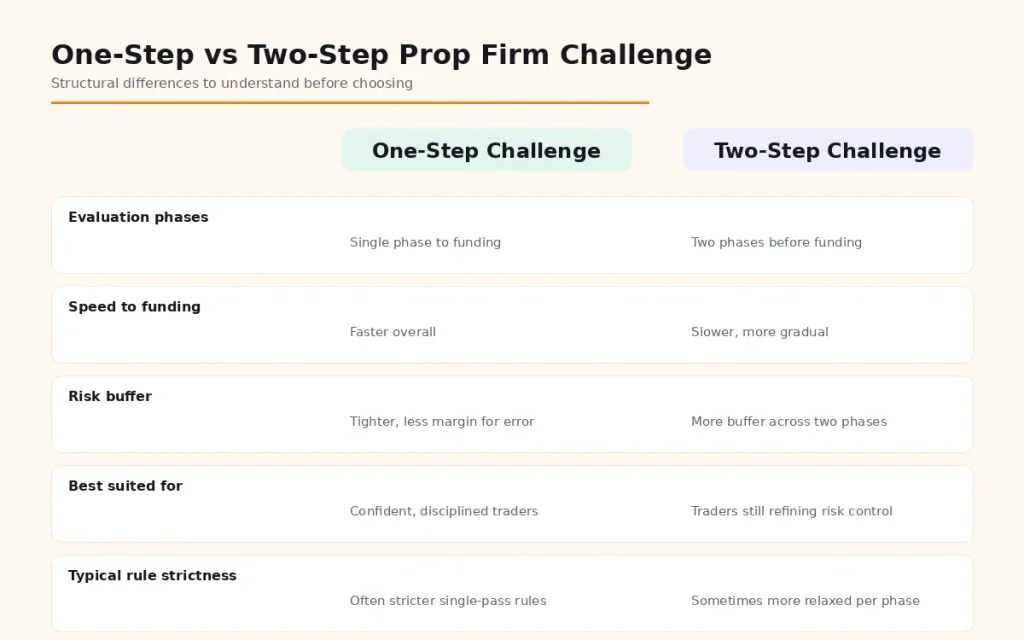
A one step prop firm challenge explained simply involves a single evaluation phase with a profit target and risk rules, while a two step prop firm evaluation explained adds a second, often more conservative phase before funding. This chapter covers how does a two step prop firm challenge work in practice, and why the extra step exists from the firm’s perspective.
Which Prop Firm Challenge Is Better for Beginners
This section compares one step vs two step prop firm challenge formats directly for beginners specifically, covering the tradeoffs between faster funding timelines and the added buffer a two-step structure provides for traders still refining their risk discipline.
Prop Firm Challenge Risk Management
This is the chapter that determines whether you pass or fail more than any other. Prop firm challenge risk management means treating the drawdown limit as the actual constraint you’re trading around, not the profit target. This section covers position sizing specifically calibrated to your challenge’s drawdown rules, and how much risk per trade for prop firm challenge accounts is genuinely sustainable without approaching your limit on a single bad session.
How to Pass a Prop Firm Challenge
Passing consistently comes down to a specific combination: respecting drawdown limits without exception, pacing your progress toward the profit target rather than rushing it, and having a defined prop firm challenge trading plan you follow regardless of how a specific session is going. This chapter pulls together the strategy elements covered earlier into a cohesive approach to how to pass a prop firm challenge specifically, not trading in general.
Prop Firm Challenge Mistakes That Cause Failure
Why Do Traders Fail Prop Firm Challenges
Most failures trace back to a handful of repeated patterns: oversized positions relative to the drawdown limit, overtrading after a string of wins, and abandoning the trading plan the moment a challenge deadline starts to feel tight. This chapter covers why do traders fail prop firm challenges in detail, using the same patterns that show up across most failed attempts.
How to Stop Overtrading in a Prop Firm Challenge
Overtrading is particularly dangerous inside a challenge specifically because every trade carries drawdown risk against a hard limit. This section covers practical ways to stop overtrading in a prop firm challenge, including pre-committing to a maximum number of trades per session.
Managing Emotions During a Prop Firm Challenge
Prop firm challenge trading psychology deserves its own focus, since the pressure of a deadline and hard risk limits creates emotional conditions different from regular trading. This chapter covers how to manage emotions during prop firm challenge attempts specifically, including recognizing when frustration is about to trigger a rule-breaking decision.
How to Avoid Failing a Prop Firm Challenge
The final section brings everything together into a practical checklist for how to avoid failing a prop firm challenge, covering the specific decision points, position sizing, daily loss awareness, and pacing toward the profit target, where most attempts actually go wrong.
Who Is This Ebook For?
The Prop Firm Challenge Guide is built for:
- Traders considering their first prop firm challenge and wanting to understand the rules before committing
- Anyone who has failed a previous evaluation and wants to understand specifically what went wrong
- Traders comparing one-step and two-step formats and unsure which fits their experience level
- Funded traders wanting to better understand drawdown rules to avoid losing their funded account
Why This Guide Is Different
Most prop firm content is either published by the firms themselves, with an obvious incentive to make the challenge sound achievable, or written generically about trading without addressing the specific rule structures that make these evaluations unique. The Prop Firm Challenge Guide is different because it treats the rules themselves, drawdown type, daily loss limits, evaluation structure, as the central strategic problem to solve, not an afterthought to a generic trading strategy.
Pass With a Real Plan, Not a Guess
A prop firm challenge isn’t just a trading test, it’s a specific set of rules that requires its own strategy. With The Prop Firm Challenge Guide, you get a clear, practical framework for understanding those rules, managing risk within them, and avoiding the mistakes that disqualify most attempts. Download this prop firm challenge guide today and give your next attempt a real plan behind it.
Frequently Asked Questions (FAQ)
Q1: What is a prop firm challenge?
A prop firm challenge is an evaluation process, usually one or two stages, where you trade under specific rules like a profit target and maximum drawdown limit, and passing results in an allocated funded account.
Q2: How do I pass a prop firm challenge?
Passing consistently requires respecting drawdown limits without exception, pacing progress toward the profit target rather than rushing, and following a defined trading plan regardless of how a specific session is going.
Q3: What’s the difference between one-step and two-step prop firm challenges?
A one-step challenge involves a single evaluation phase, while a two-step format adds a second, often more conservative phase before funding, generally offering more buffer for traders still refining their risk discipline.
Q4: What is trailing drawdown vs static drawdown?
Static drawdown stays fixed relative to your starting balance, while trailing drawdown moves upward as your account grows, meaning your allowed risk cushion can shrink even while you’re profitable.
Q5: Why do most traders fail prop firm challenges?
Common causes include oversized positions relative to the drawdown limit, overtrading after a winning streak, and abandoning the trading plan when a deadline starts to feel tight.
Q6: How do I access the ebook after purchasing it?
After purchase, you’ll get instant digital access to download the ebook, readable on any device including your phone, tablet, or computer.



Reviews
There are no reviews yet.