


Wyckoff Analytics – Market Profile & Volume Analytics Trading Strategies
Wyckoff Analytics – Market Profile & Volume Analytics Trading Strategies is a course or learning resource focused on its stated subject. The description below outlines the available material and the areas covered by the original course information.
About Course :-
Market Profile Trading Strategy: How Volume Analytics Reveal Institutional Order Flow (Wyckoff Method Guide)
Learn how professional traders read Market Profile charts and volume analytics to spot institutional buying and selling before the crowd does.
Veteran trader and educator Damon Pavlatos is pulling back the curtain on two of the most underused tools in retail trading: Market Profile analysis and volume analytics. Together, these techniques form a powerful price-and-volume companion to the Wyckoff Method, giving traders a sharper lens on what “smart money” is actually doing — not just what price is doing.
What You Get :-
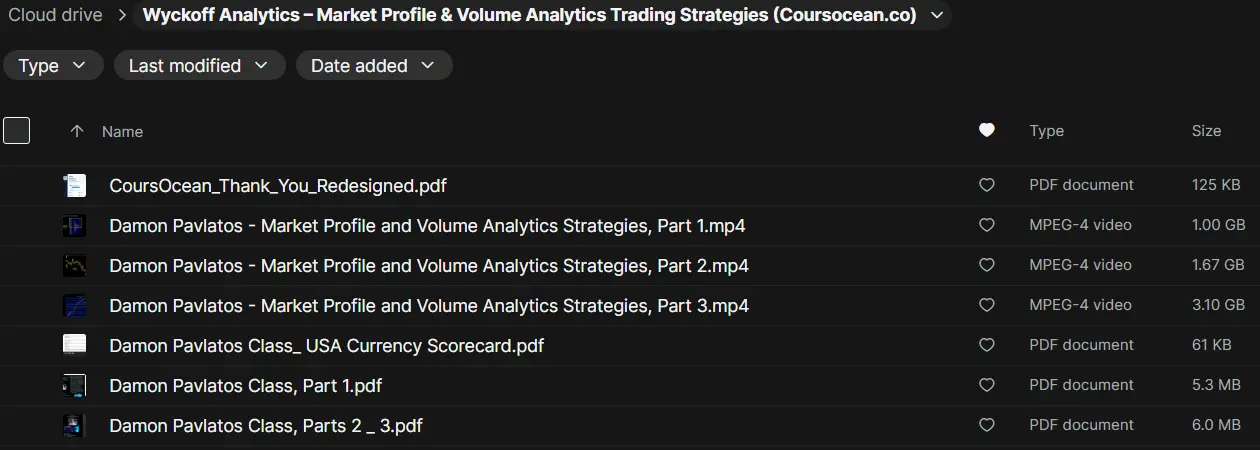
All Content & File Size — Point to Point
- Coursocean_Thank_You_Redesigned.pdf — 125 KB
- Damon Pavlatos – Market Profile and Volume Analytics Strategies, Part 1.mp4 — 1.00 GB
- Damon Pavlatos – Market Profile and Volume Analytics Strategies, Part 2.mp4 — 1.67 GB
- Damon Pavlatos – Market Profile and Volume Analytics Strategies, Part 3.mp4 — 3.10 GB
- Damon Pavlatos Class_USA Currency Scorecard.pdf — 61 KB
- Damon Pavlatos Class, Part 1.pdf — 5.3 MB
- Damon Pavlatos Class, Parts 2 _ 3.pdf — 6.0 MB
Total: approximately 5.78 GB.
What Is Market Profile Analysis (And Why It Matters for Traders)
At its core, Market Profile trading is built on a simple but powerful idea: every freely traded market behaves like an auction. Buyers and sellers are constantly negotiating a “fair price,” and that negotiation leaves fingerprints — if you know where to look.
Market Profile charts let traders pinpoint exactly where the patient, well-capitalized, well-informed participants (think institutions, market makers, and large funds) are most active. That, in turn, reveals the real strength of supply and demand at specific price levels — information that standard candlestick charts simply don’t show.
How Volume Profile Charts Expose Institutional Order Flow
Instead of just tracking price movement over time, Market Profile plots the relative volume traded at each price level. The result is a horizontal volume histogram that maps out value areas — the price zones where institutional order flow is concentrated.
For retail traders, this unlocks three major advantages:
- Spotting value zones created by large institutional participants
- Anticipating directional bias during consolidation or sideways price action, on any timeframe
- Identifying high-probability reversal levels before the broader market catches on
If you’ve ever felt like the market “just knows” where to bounce or reject, volume profile analysis is often the missing piece explaining why.
Why Most Traders Misunderstand Market Profile Charts
Here’s the irony: a lot of traders have seen those colorful, multi-hued Market Profile charts scattered across trading forums and platforms — but very few actually understand what they’re looking at, or how to trade with them.
That’s the gap this training closes.
Drawing on decades of hands-on trading experience with Market Profile and volume analytics, Damon Pavlatos breaks down these charts in plain language, showing exactly how they capture the real-time push and pull of supply and demand at different price points.
Free 3-Part Webinar Series: Market Profile & Volume Analytics for Traders
This foundational, three-part webinar series is designed for traders at every level — whether you’re just starting out or you’ve been reading charts for years. You’ll walk away understanding:
- The auction market theory behind Market Profile
- How to read volume-at-price data like an institutional trader
- How to combine Market Profile with the Wyckoff Method for sharper trade timing
- How to spot low-risk reversal zones and consolidation breakouts
Whether your focus is day trading, swing trading, or futures and forex trading, this is a rare chance to learn a professional-grade edge from a trader who’s used it for decades.
Frequently Asked Questions
1. What is Market Profile in trading, and how is it different from a regular chart?
A regular price chart only tells you where price went over time. Market Profile flips that around — it shows you where the volume actually happened, at each price level, so you can see which prices the market spent the most time and volume agreeing on. Think of it as an “auction map” instead of a timeline. That’s why traders describe Market Profile as showing value, not just price.
2. Is Market Profile the same thing as Volume Profile?
Not exactly, though people use the terms interchangeably. Volume Profile is a broader charting tool that plots traded volume at each price level. Market Profile is a specific version of this idea, rooted in auction market theory, that also factors in time spent at each price (not just volume). In practice, most retail platforms blend the two, which is exactly why so many traders get confused — this course is built to clear that confusion up.
3. Can beginners actually learn Market Profile, or is it only for advanced traders?
This is one of the most common worries traders have before diving in, and the honest answer is: yes, beginners can learn it — as long as it’s taught in plain language instead of jargon. That’s the whole point of this three-part webinar series. Damon Pavlatos breaks the concept down step by step, starting with the auction theory basics, so you don’t need years of chart experience to follow along.
4. What can Market Profile charts tell you about support and resistance?
Market Profile identifies “value areas” — price zones where the heaviest volume and institutional activity took place. These zones often act as natural support and resistance because that’s where the market previously found agreement on price. When price returns to one of these zones, traders watch closely for a bounce, a rejection, or a breakout, since that’s historically where the big players have been most active.
View More Courses – Click Here
Explore More WorldCourse Products
Continue exploring related learning resources from WorldCourse:



Reviews
There are no reviews yet.