
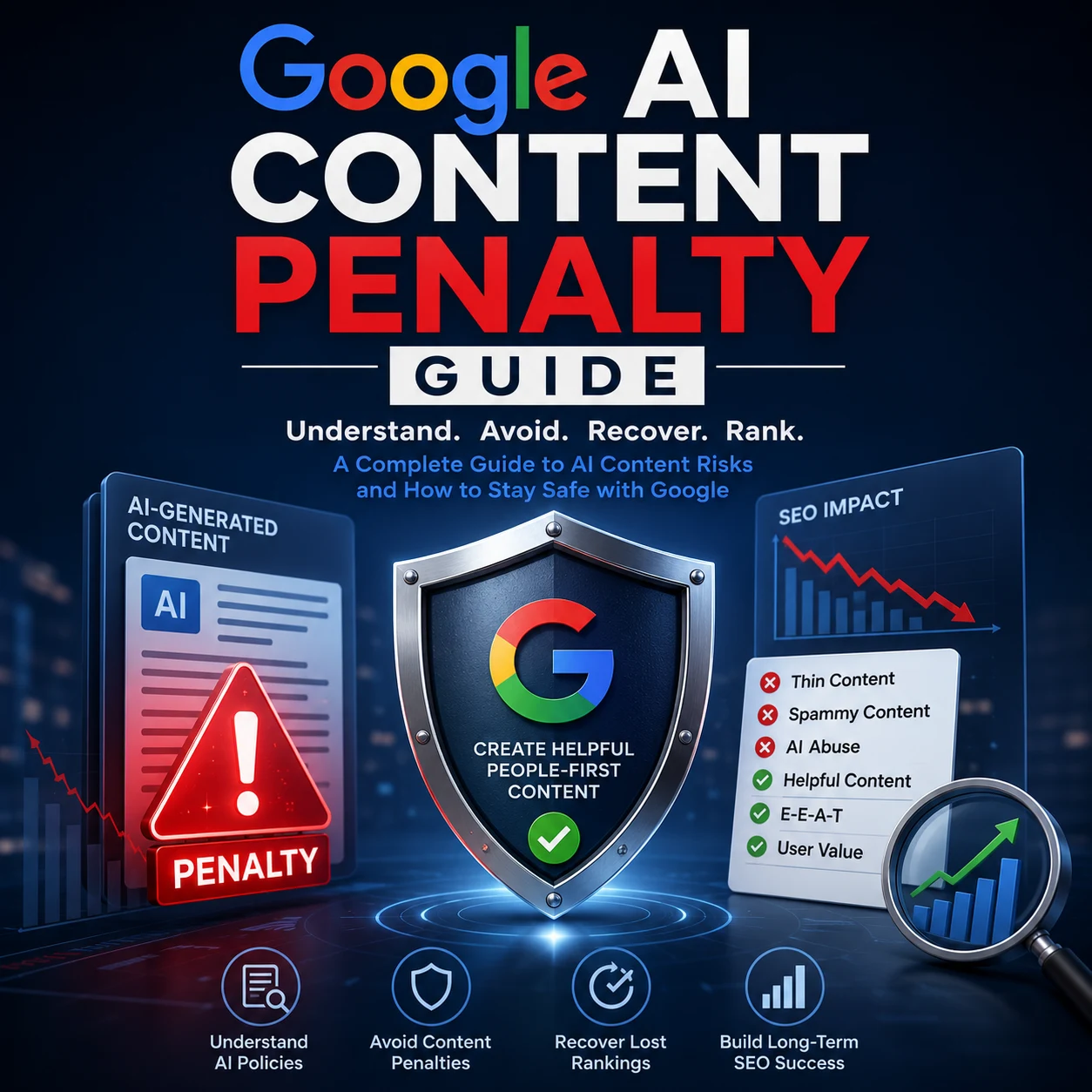


Search has changed faster in the last two years than in the previous ten, and a lot of sites are getting caught off guard, not by bad intentions, but by outdated assumptions about how content gets rewarded. A Google AI content penalty can hit sites that genuinely believed they were doing everything right, simply because the rules shifted underneath them. The Google AI Content Penalty Guide exists to make sure that doesn’t happen to you, or to help you recover clearly if it already has.
This isn’t a guide built on speculation or panic. It’s a practical breakdown of what actually triggers a Google AI content penalty, the SEO principles that still hold up in this new environment, and the specific tools and strategies worth using to stay visible across both traditional search and AI-driven discovery.
What Actually Triggers a Google AI Content Penalty
Understanding the Shift Behind the Penalty
A Google AI content penalty generally isn’t about using AI to help write content, it’s about publishing content that lacks genuine value, originality, or expertise, patterns that became far easier to mass-produce once AI tools became widely available. This chapter breaks down the actual signals Google evaluates, separating myth from what genuinely puts a site at risk.
Common Mistakes That Lead to a Penalty
Learn the specific, avoidable mistakes that commonly precede a Google AI content penalty: thin, templated content published at scale, lack of demonstrated expertise, and content that mirrors competitors too closely without adding genuine value of its own.
SEO Principles That Still Matter in the AI Era
Despite everything changing on the surface, the core seo principles that have mattered for years haven’t disappeared, they’ve just been re-weighted. This chapter covers which foundational principles, genuine expertise, user-focused content, and technical health, matter more than ever, and which older tactics have quietly stopped working.
SEO Positioning in a Post-AI Search Landscape
Your seo positioning, how your site is understood to fit within its topic and audience, matters more now than when rankings were purely about keyword matching. This section covers how to think about positioning your site clearly enough that both traditional algorithms and AI systems can accurately understand what you offer.
Reassessing SEO Value After Algorithm Shifts
This chapter covers how to reassess the actual seo value of your existing content and strategies, since what delivered strong seo value two years ago may now be neutral, or even working against you, under current evaluation standards.
Choosing the Right AI Mode SEO Tool
As search itself becomes AI-powered, the tools used to monitor and optimize for it have evolved too. This chapter covers what to actually look for in an ai mode seo tool, distinguishing genuinely useful monitoring capabilities from repackaged traditional SEO software with an AI label attached.
Best AI SEO Tools 2026 for Staying Penalty-Free
This section covers the categories worth evaluating among the best ai seo tools 2026 has to offer, focused specifically on tools that help identify content quality issues, monitor AI search visibility, and flag patterns that could trigger a Google AI content penalty before it happens.
How to Track Brand Mentions in AI Search
Traditional backlink tracking doesn’t capture the whole picture anymore. This chapter covers how to track brand mentions in AI search specifically, monitoring how and where your brand gets referenced or summarized by AI systems, even without a traditional clickable link.
Understanding LLM Visibility as a New Metric
An llm visibility tool measures something genuinely different from traditional rank tracking: how frequently and accurately your content gets referenced or cited by large language models when users ask AI systems questions related to your expertise. This section covers why this metric increasingly matters alongside traditional rankings.
Search Engines That Don’t Use AI: An Overlooked Strategy
While most attention goes to AI-driven search, this chapter covers search engines that don’t use AI, or use it minimally, and why maintaining visibility there provides a valuable hedge against over-relying on any single search paradigm, especially while AI search algorithms are still actively evolving.
Content Strategy Going Forward
SEO Friendly Content Writing Services vs Doing It Yourself
This chapter honestly compares using seo friendly content writing services against handling content creation in-house, covering the tradeoffs in cost, consistency, and quality control that matter most when you’re specifically trying to avoid a Google AI content penalty.
Working With an On-Page SEO Service for Recovery
If your site has already been affected, this section covers what a genuinely effective on page seo service should actually address during recovery: technical health, content quality audits, and structural fixes, not just superficial keyword adjustments.
Who Is This Ebook For?
The Google AI Content Penalty Guide is built for:
- Site owners worried they might be at risk of a Google AI content penalty
- Anyone who has already been hit and needs a clear, practical recovery path
- Content teams trying to understand which seo principles still apply in the current environment
- Marketers evaluating an ai mode seo tool or llm visibility tool for the first time
Why This Guide Is Different
Most content about AI and SEO is either fear-based clickbait or vague reassurance without practical steps. The Google AI Content Penalty Guide is different because it separates genuine risk factors from myths, and gives you specific, actionable steps rather than general anxiety about “the algorithm changing.”
Protect Your Site Before, or After, It’s Affected
A Google AI content penalty doesn’t have to be a mystery, or a disaster you can’t recover from. With the Google AI Content Penalty Guide, you get a clear, practical framework for understanding the risk, choosing the right tools, and building content that holds up under current standards. Download it today and stop guessing about what actually keeps your site safe.
Frequently Asked Questions (FAQ)
Q1: What is a Google AI content penalty?
A Google AI content penalty generally refers to a drop in visibility caused by content that lacks genuine value, originality, or demonstrated expertise, patterns that became easier to produce at scale with AI tools, rather than a penalty for simply using AI assistance itself.
Q2: Does using AI to help write content automatically cause a Google AI content penalty?
No, the core issue is content quality and genuine value, not the tool used to produce it. Thin, templated, low-value content is the actual risk factor, regardless of whether AI was involved in writing it.
Q3: What is an LLM visibility tool, and why does it matter?
An LLM visibility tool measures how frequently and accurately your content gets referenced by AI systems like ChatGPT or Gemini when users ask related questions, a metric that matters increasingly alongside traditional search rankings.
Q4: Should I still care about search engines that don’t use AI?
Yes, maintaining visibility across search engines that don’t use AI, or use it minimally, provides a valuable hedge while AI-driven search algorithms are still actively evolving and changing.
Q5: How do I track brand mentions in AI search specifically?
This generally involves monitoring how your brand or content gets referenced or summarized within AI-generated answers, even without a traditional clickable link, which requires different tools than standard backlink tracking.
Q6: How do I access the ebook after purchasing it?
After purchase, you’ll get instant digital access to download the ebook, readable on any device including your phone, tablet, or computer.
Explore More on WorldCourse
- Building without code? Check The NoCode SaaS WebDev Blueprint
- Growing an online store? See the Ecommerce Brand Scaling Guide
- Organize your work with the Digital Productivity Knowledge Systems Compendium
- Browse more ebooks and guides on WorldCourse
- Have questions about this ebook? Contact our support team




Reviews
There are no reviews yet.