
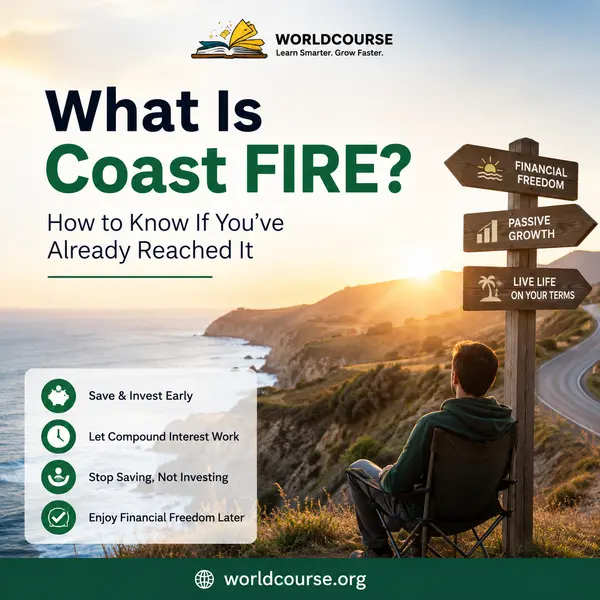
Somewhere between “still grinding toward retirement” and “fully financially independent” sits a lesser-known milestone that more people are searching for lately: Coast FIRE. Unlike traditional FIRE, which focuses on saving enough to stop working entirely, Coast FIRE asks a different, arguably more useful question — have you already saved enough that your current investments will grow into a full retirement on their own, without adding another dollar?
If that sounds surprising, you’re not alone. Coast FIRE has quietly become one of the fastest-growing terms in personal finance searches, and for good reason. It reframes retirement planning in a way that feels far more achievable, and far less abstract, than most financial independence advice.
What Is Coast FIRE, Exactly?
Coast FIRE is the point at which you’ve saved and invested enough money that, left untouched and allowed to grow through compound interest alone, it will reach your full retirement number by your target retirement age, without requiring any additional contributions.
Once you hit this point, you can technically “coast,” meaning you no longer need to save aggressively for retirement specifically. You still need to cover your current living expenses through work or other income, but the retirement portion of your financial life is essentially on autopilot.
This is different from traditional FIRE (Financial Independence, Retire Early), which requires saving enough to cover your entire living expenses without working at all. Coast FIRE is a more accessible middle ground, one that a meaningfully larger number of people can realistically reach.
How Does Coast FIRE Work?
The mechanism behind Coast FIRE is compound growth. Money invested today has decades to grow before you’ll actually need it, and that growth compounds significantly over long timeframes, even without additional contributions.
This means someone who saves aggressively in their 20s and 30s, then stops actively contributing to retirement accounts, can still end up with a fully funded retirement by 60 or 65, simply because their earlier contributions had enough time to compound.
The earlier you front-load your retirement savings, the smaller the amount you actually need to reach Coast FIRE, since your money has more years to grow. This is the core insight that makes Coast FIRE so appealing: time, not just total savings, does much of the heavy lifting.
How Much Do You Need for Coast FIRE?
There’s no single number, since it depends entirely on your target retirement age, your desired retirement income, and your current age. However, the general approach to a Coast FIRE calculation involves working backward from your full retirement number.
Start with your target retirement number. This is generally calculated as 25 times your desired annual retirement spending, based on a commonly used 4% safe withdrawal rate.
Work backward using compound growth. Using an assumed average annual return (often estimated conservatively around 7% after inflation for diversified index investments), you can calculate how much you’d need invested today for that amount to grow into your full retirement number by your target age, with no further contributions.
Compare that number to your current savings. If your current retirement savings already exceed that calculated amount, you’ve technically reached Coast FIRE.
This is why a Coast FIRE calculator is such a commonly searched tool. Manually running these compound growth calculations across different timeframes and return assumptions is tedious, so many people prefer a calculator that lets them adjust variables and see results instantly.
Coast FIRE vs Regular FIRE: What’s the Real Difference?
Traditional FIRE requires your investments to cover 100% of your living expenses immediately, allowing you to stop working entirely. It requires an enormous amount of savings relative to your spending, since your entire lifestyle depends on investment returns alone.
Coast FIRE only requires enough saved for retirement specifically, while you continue working, freelancing, or doing lower-stress, lower-paying work to cover current expenses. This is a meaningfully lower bar, which is part of why it resonates with people who find traditional FIRE targets unrealistic or overly restrictive.
In practice, many people who reach Coast FIRE don’t stop working entirely, they simply gain the freedom to make different career choices. Taking a lower-paying but more fulfilling job, reducing hours, or pursuing work they actually enjoy becomes possible once retirement savings are no longer dependent on continued aggressive contributions.
Am I Coast FIRE? How to Actually Check
To figure out where you stand, you’ll need three numbers: your current age, your target retirement age, and your current retirement savings total. From there, a Coast FIRE calculation shows you what your current savings will grow into by retirement age, assuming no further contributions and a reasonable average investment return.
If that projected number meets or exceeds your target retirement number, you’ve reached Coast FIRE. If it falls short, the gap tells you either how much more you’d need to save, or how much longer you’d need to keep contributing before you could comfortably coast.
It’s worth running this calculation periodically, since market performance, changes in your target retirement age, or shifts in your desired retirement lifestyle can all move the goalposts over time.
Why Coast FIRE Resonates With So Many People Right Now
Traditional financial independence advice can feel discouraging, especially for people who started saving later or don’t have access to unusually high incomes. Coast FIRE offers a more realistic, incremental way to think about financial progress, one that acknowledges meaningful milestones exist well before “fully retired,” and that reaching one of those milestones is genuinely worth recognizing.
It also shifts the focus toward front-loading retirement savings while young, which aligns naturally with how compound growth actually works, rather than treating retirement saving as something to figure out later.
Building the Habits That Get You There
Reaching Coast FIRE, or any meaningful financial milestone, depends less on finding one clever trick and more on consistent, sustainable money habits over time. If you’re working on strengthening those fundamentals, our Money Mindset and Financial Freedom ebook covers the practical habits that make consistent saving and investing sustainable, not just theoretically possible.
And if you’re looking to build income streams that support your broader financial goals alongside your retirement savings, our Passive Income Blueprint walks through realistic ways to build income that doesn’t depend entirely on trading hours for dollars, which pairs naturally with a Coast FIRE strategy once you’re no longer required to save aggressively.
If avoiding the everyday habits that quietly work against your financial goals is also something you’re thinking about, our related post on 10 Money Habits That Are Quietly Making You Poor in 2026 covers the small leaks worth plugging first.
Frequently Asked Questions (FAQ)
Q1: What is Coast FIRE in simple terms?
Coast FIRE is the point where you’ve saved enough for retirement that, left to grow through compound interest alone, it will reach your full retirement number by your target age without any further contributions.
Q2: How is Coast FIRE different from regular FIRE?
Regular FIRE requires enough savings to cover 100% of your living expenses immediately, allowing you to stop working entirely. Coast FIRE only requires enough saved specifically for retirement, while you continue working to cover current expenses.
Q3: How much money do you need to reach Coast FIRE?
It depends on your current age, target retirement age, and desired retirement spending. A Coast FIRE calculator works backward from your full retirement number using compound growth assumptions to determine how much you’d need saved today.
Q4: Can you check if you’ve already reached Coast FIRE?
Yes, by comparing your current retirement savings to the amount needed today that would grow into your full retirement number by your target age, assuming no further contributions and a reasonable average investment return.
Q5: Do you have to stop working once you reach Coast FIRE?
No, most people who reach Coast FIRE continue working, but gain the flexibility to pursue lower-stress or more fulfilling work, since their retirement savings no longer depend on continued aggressive contributions.
Q6: Why does starting early matter so much for Coast FIRE?
Because compound growth needs time to work. Money invested earlier has more years to grow, meaning the total amount needed to reach Coast FIRE is significantly smaller for someone who starts saving in their 20s compared to later.
Explore More on WorldCourse
- Build sustainable saving and investing habits with Money Mindset and Financial Freedom
- Build income that supports your goals with the Passive Income Blueprint
- Related read: 10 Money Habits That Are Quietly Making You Poor in 2026
- Browse the full ebooks and guides library
- Read more on our blog
- Have questions? Contact our support team