
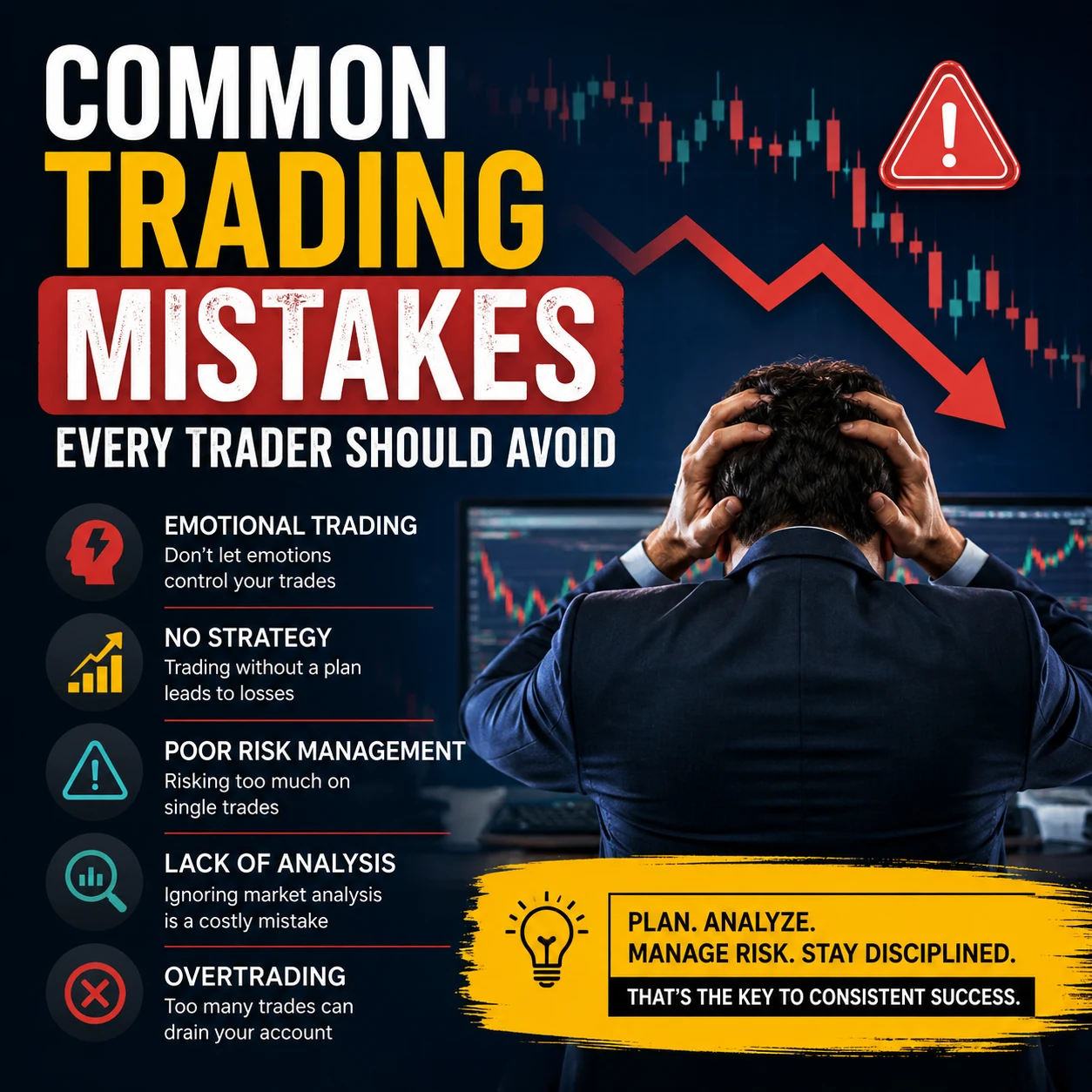
Almost every trader makes the same handful of common trading mistakes on the way to figuring out what actually works, the difference between traders who improve and traders who don’t usually comes down to whether they recognize the pattern or keep repeating it. This list of common trading mistakes covers the 10 that show up most often, whether you’re trading forex, stocks, or crypto, and what to actually do instead of each one.
1. Trading Without a Clear Strategy
One of the most common forex trading mistakes, and honestly one of the common trading mistakes across any market, is entering trades without a defined strategy behind the decision. Solid forex trading strategies give you a repeatable framework for entries, exits, and risk, without one, every trade becomes a fresh guess made under pressure. If you’re still figuring out how to start forex trading, building a basic strategy before your first live trade saves you from a lot of early, avoidable losses.
2. Risking Too Much on a Single Trade
This is one of the risk management mistakes that quietly ends more trading careers than bad market calls ever do. Risking a large percentage of your account on one position means a single loss can undo weeks of gains, regardless of how good your overall strategy actually is. Fixing this one mistake alone prevents most of the account-ending scenarios traders eventually run into.
3. Trading Based on Emotions
Bad decisions rarely feel bad in the moment, they feel like conviction, urgency, or a hunch worth acting on. Emotional trading mistakes, buying out of excitement or selling out of panic, override whatever plan was in place before the trade, which is exactly why they’re so damaging. Recognizing when a decision is coming from emotion rather than analysis is a skill worth building deliberately, not something that improves automatically with more screen time.
4. Overtrading in the Forex Market
Forex day trading in particular tends to invite overtrading, since the market is open nearly around the clock and it’s always tempting to find “one more setup.” Forex day trading mistakes often come down to volume rather than judgment, more trades taken simply because the opportunity to trade is constantly available, not because each one is genuinely well-reasoned.
5. Ignoring Price Action and Market Structure
Price action, how price actually moves and behaves on the chart, gets skipped by traders who rely too heavily on indicators without understanding the underlying structure those indicators are built on top of. Price action mistakes usually involve ignoring obvious support, resistance, or trend structure in favor of a signal that technically fired but doesn’t fit the broader context.
6. Entering Trades Without Proper Analysis
This connects directly to skipping technical analysis of the financial markets altogether, jumping into a trade based on a tip, a feeling, or a headline rather than any actual analysis of the setup. Common mistakes in forex trading often start right here, at the entry decision itself, before risk management or psychology even come into play.
7. Using Excessive Leverage
Leverage amplifies both gains and losses, and new traders frequently use far more of it than their actual risk tolerance or experience level can support. This is one of the trading mistakes beginners make most consistently, since higher leverage feels like a shortcut to bigger returns without fully registering the equivalent increase in downside risk.
8. Failing to Use a Stop-Loss
Trading without a stop-loss means a single trade has no defined limit on how much it can cost you, turning what should be a controlled loss into an open-ended one. This is consistently listed among the most damaging risk management mistakes, since it removes the one safeguard specifically designed to prevent a bad trade from becoming a catastrophic one.
9. Changing Your Strategy After a Few Losses
Abandoning a strategy after two or three losing trades, before it’s had a fair statistical sample to actually prove itself, is one of the more subtle common trading mistakes on this list. It leads to strategy-hopping, where a trader never sticks with any single approach long enough to know whether it genuinely works or not.
Common Mistakes Traders Make at Prop Firms
Traders working with a proprietary trading firm face a specific version of several mistakes above, amplified by firm-specific rules around drawdown limits and evaluation targets. A common mistake here is treating a funded account exactly like a personal account, without adjusting for the firm’s specific risk parameters. If you’re researching prop firms or comparing the best prop firms to work with, understanding these firm-specific risk rules matters just as much as evaluating their profit splits or funding terms.
10. How Beginners Can Avoid Common Trading Mistakes
Avoiding common trading mistakes isn’t about being naturally gifted at trading, it’s about building specific habits that directly counter each mistake above: a written strategy before entering any trade, a hard risk limit per position, a stop-loss on every trade without exception, and enough distance from the outcome of any single trade to avoid emotional decision-making. Beginners who build these habits early tend to progress faster than those relying purely on natural instinct, and they tend to make far fewer common trading mistakes as a result.
Going Deeper Into Each Mistake
Several of the mistakes above deserve more depth than a single section in a list of common trading mistakes can provide. Our Modern Traders Risk Playbook covers risk management, position sizing, and stop-loss discipline in full detail, while Is Day Trading Worth It? A Trading Psychology Guide goes deep into the emotional trading patterns behind several of these mistakes. If you’re still building your first trading habits, our Trading Journal Habit Guide covers how to actually track and catch these mistakes in your own trading over time. And for a broader look at why these patterns lead to losses in the first place, see our related posts on why most traders lose money and why do traders lose money.
Frequently Asked Questions (FAQ)
Q1: What are the most common trading mistakes beginners make?
The most common trading mistakes include trading without a clear strategy, risking too much on a single trade, emotional decision-making, overtrading, and failing to use a stop-loss consistently.
Q2: What are common forex trading mistakes specifically?
Common forex trading mistakes include overtrading due to the market’s near 24-hour availability, using excessive leverage, and entering trades without proper technical analysis or a clear strategy behind the decision.
Q3: How can I avoid common trading mistakes as a beginner?
Building specific habits, a written strategy, a defined risk limit per trade, consistent stop-loss use, and enough emotional distance from any single trade’s outcome, directly addresses most common trading mistakes at their root.
Q4: Why is using a stop-loss so important for avoiding trading mistakes?
A stop-loss defines the maximum a single trade can cost you in advance, preventing an otherwise manageable loss from turning into a much larger, uncontrolled one.
Q5: Are the mistakes different when trading with a proprietary trading firm?
Not fundamentally, but prop firm traders need to additionally account for firm-specific rules around drawdown limits and evaluation targets, which adds a layer of risk management beyond personal account trading alone.
Q6: Why do traders abandon a good strategy after just a few losses?
This usually happens because losses feel like evidence the strategy is broken, even when a small sample of losing trades is statistically normal for many legitimate strategies, leading traders to switch before giving any approach a fair test.
Explore More on WorldCourse
- Related read: Why Most Traders Lose Money — It’s Not the Strategy, It’s This
- Related read: Why Do Traders Lose Money? 7 Common Reasons
- Build a real risk system with the Modern Traders Risk Playbook
- Understand the psychology behind trading in Is Day Trading Worth It? A Trading Psychology Guide
- Build the habit that actually sticks with the Trading Journal Habit Guide
- Browse the full ebooks and guides library
- Have questions? Contact our support team