
Type “why do traders lose money” into Google and you’ll find no shortage of vague answers, “the market is hard,” “most people just aren’t cut out for it.” Neither is actually true, or at least, neither is the real explanation. If you’re genuinely trying to understand why do traders lose money, the answer is far more specific and far more fixable than most content admits. Traders lose money for specific, identifiable, and mostly avoidable reasons, and once you can name them, they get a lot easier to catch in yourself before they cost you.
Why Do Traders Lose Money? A Quick Look at the Real Patterns
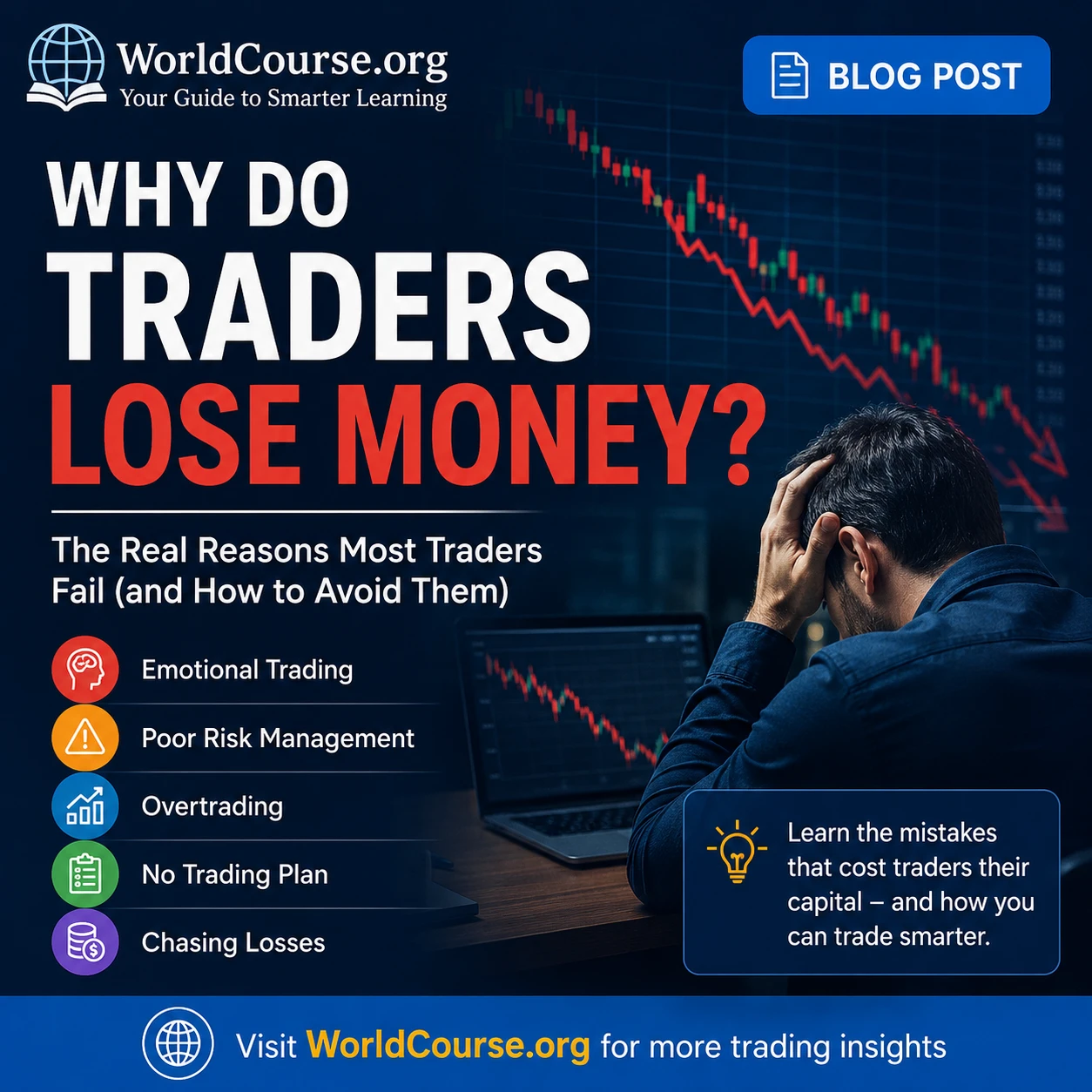
Most of the time, why do traders lose money comes down to a handful of repeated patterns: poor risk management, emotional decision-making, and a lack of any real plan to fall back on when things go wrong. It’s rarely a single catastrophic trade. It’s usually a series of smaller, avoidable mistakes that compound over time.
7 Reasons Why Traders Lose Money
If you’ve been wondering why do traders lose money in your own trading specifically, these seven patterns are worth checking yourself against honestly, one at a time.
1. Poor Risk Management
This is consistently the number one answer to why do traders lose money, and it’s rarely close. Trading without a clear stop loss, without defined position sizing, or without any real limit on how much a single trade can cost you, means one bad move can undo weeks of gains. Solid trading risk management isn’t glamorous, but it’s the difference between a rough week and a wiped-out account.
2. Oversized Positions
Related to risk management but worth calling out separately, and honestly one of the most common reasons why do traders lose money on trades that were otherwise well-chosen: position sizing that’s too large relative to account size turns normal market movement into a serious threat. A trade that should be a minor, forgettable loss becomes a major setback purely because too much was riding on it.
3. Emotional Decision-Making
Emotional trading, buying out of excitement, selling out of panic, overrides logic at exactly the moments it matters most, often even when the underlying strategy behind the trade was perfectly sound. Markets are designed to trigger fear and greed at their extremes, and traders who let those emotions drive decisions consistently buy high and sell low, the opposite of the goal.
4. Revenge Trading
After a loss, the urge to immediately win it back is powerful, and dangerous, and it’s a pattern that shows up in almost every honest account of why do traders lose money after an otherwise decent stretch. Revenge trading, jumping back in with a bigger position specifically to recover a previous loss, tends to compound damage rather than fix it, since it’s driven by emotion rather than any actual strategy.
5. Overtrading
More trades doesn’t mean more opportunity, it often means more fees, more mistakes, and less discipline. Overtrading, taking trades out of boredom or a compulsion to always be active in the market, is one of the quieter answers to why do traders lose money, since each individual trade might look reasonable while the cumulative pattern is what actually causes damage.
6. No Trading Plan
Trading without a plan means every decision gets made in the moment, under pressure, without a framework to fall back on, and that’s true even for traders who know better once they’ve had time to calm down and think it through. A real plan defines entry and exit criteria, risk limits, and position sizing before emotions are involved, removing a huge amount of the guesswork that leads to costly mistakes.
7. Ignoring Market Risk
Market risk, the broader risk that comes from overall market movement rather than any specific trade, gets ignored more often than it should. Traders who don’t account for market-wide volatility or broader conditions can find even well-planned individual trades wiped out by forces entirely outside their strategy.
How Much Do Day Traders Make—and Why Do So Many Lose Money?
This is one of the more honest questions worth asking directly, and it circles back to why do traders lose money from a slightly different angle. Studies and broker data consistently show that a majority of active day traders lose money over time, and the ones who do profit tend to be a small percentage with significant experience and strict risk discipline. The gap between how much day traders make in theory versus in practice comes down almost entirely to the seven reasons above, not a lack of available opportunity in the markets themselves.
How Market Risk Causes Traders to Lose Money
Even a well-executed individual trade can lose money if broader market risk moves against the overall direction of that trade, sometimes with nothing wrong with the original logic behind it at all. This is why risk management in trading has to account for more than just the specific position, it needs to consider what happens if the broader market shifts unexpectedly, and how much exposure that creates across your entire account, not just one trade at a time.
Why Traders Struggle in a Down Market
Investing in a down market tests every weakness listed above simultaneously, and it’s often where people finally start asking why do traders lose money after years of a rising market hiding the problem. Emotional trading intensifies as losses mount, revenge trading becomes more tempting, and poor risk management gets punished faster. Traders who struggle most in down markets are usually the same ones already carrying oversized positions or lacking a real plan, the down market simply reveals problems that were already there.
How to Stop Losing Money in Trading
The seven reasons above aren’t just a list of problems, they’re a checklist for what to actually fix, and together they answer why do traders lose money far more precisely than “the market is hard” ever could. Building genuine trading risk management, removing emotional trading from the decision process, writing an actual plan before entering trades, and respecting position sizing limits address the root causes directly, rather than chasing a “better” strategy that won’t fix an underlying discipline problem.
Risk Management Rules Every Trader Should Know
Understanding why do traders lose money is only useful if it changes what you actually do next. These rules turn the seven reasons above into daily habits.
Always define your stop loss before entering a trade, not after it starts moving against you, when emotion makes that decision far harder to make rationally.
Size positions based on account risk, not conviction. How confident you feel about a trade shouldn’t determine position size, your predefined risk tolerance should.
Separate your trading plan from your emotional state. Decisions made in a moment of excitement or panic are far more likely to violate your own risk rules than decisions made calmly in advance.
Review losses honestly, not defensively. Understanding why a specific loss happened, mechanically, not emotionally, is what actually prevents repeating it.
Going Deeper Into Each Root Cause
This article covers the seven core reasons at a high level, but each one deserves more depth than a single section can provide. Our Modern Traders Risk Playbook covers risk management and position sizing in full detail, while our Is Day Trading Worth It? A Trading Psychology Guide goes deep into the emotional trading, revenge trading, and overtrading patterns covered briefly here. For a broader look at why most traders lose money and it’s rarely the strategy itself, our related pillar article breaks down the mindset shift that ties all seven reasons together.
Frequently Asked Questions (FAQ)
Q1: Why do traders lose money most often?
Most traders lose money due to a combination of poor risk management, emotional decision-making, and a lack of a defined trading plan, rather than one single catastrophic mistake.
Q2: Why do day traders lose money specifically?
Day traders face the same core issues as other traders, but the faster pace of day trading amplifies emotional decision-making, overtrading, and poor position sizing, making disciplined risk management even more critical.
Q3: How much money do you need to trade?
The amount needed depends on your goal, learning the mechanics can start with a small amount, while generating meaningful income typically requires a larger account so responsible position sizing produces worthwhile results.
Q4: Can you make money in every market, including a down market?
It’s possible, but investing in a down market tends to expose existing weaknesses in risk management and discipline more quickly than a rising market does, making solid fundamentals even more important.
Q5: What is the single biggest reason traders fail?
Poor risk management is consistently cited as the most common root cause, since it turns individually survivable mistakes into account-damaging losses.
Q6: Is trading psychology really as important as strategy?
Yes, emotional trading, revenge trading, and overtrading are all psychology-driven behaviors that can undermine even a statistically sound strategy, which is why psychology is treated as equally important as technical skill.
Explore More on WorldCourse
- Related read: Why Most Traders Lose Money — It’s Not the Strategy, It’s This
- Build a real risk system with the Modern Traders Risk Playbook
- Understand the psychology behind trading in Is Day Trading Worth It? A Trading Psychology Guide
- Build the habit that actually sticks with the Trading Journal Habit Guide
- How much do you actually need? See How Much Money to Start Trading
- Browse the full ebooks and guides library
- Have questions? Contact our support team