
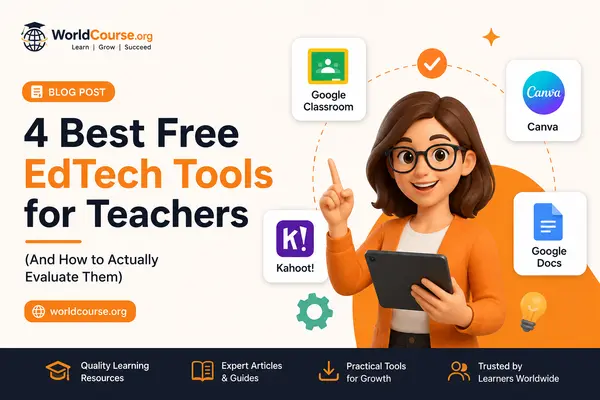
Every “best free edtech tools” list online looks basically the same: a rotating cast of the same ten apps, ranked by whoever’s paying for placement that month. Instead of just adding another list to that pile, this covers something more useful, the actual categories of best free edtech tools worth your time, and a simple way to evaluate any specific tool you come across, this year or three years from now when the list has completely changed.
Why Most “Best Free Tools” Lists Aren’t That Helpful
Lists of tools for teachers tend to go stale within months, new apps launch, old ones get bought out or shut down, and pricing models change constantly. What doesn’t go stale is knowing how to evaluate a tool yourself, which is a far more durable skill than memorizing this year’s specific app names.
4 Genuinely Useful Categories of Best Free EdTech Tools
Classroom Management and Communication
Free tools in this category handle attendance, parent communication, and daily logistics. The genuine time savings here tend to be real and immediate, since these tasks were manual and repetitive before, making this one of the easier categories to evaluate quickly.
Formative Assessment and Quick Checks
Free quiz and polling tools let you check understanding in real time during a lesson, rather than waiting for a formal assessment to find out students missed something. These tools for teachers are genuinely useful when they’re fast to set up, since a tool that takes fifteen minutes to configure for a five-minute check defeats its own purpose.
AI-Assisted Planning and Content Creation
A growing number of free tools use AI to help draft lesson plans, generate practice questions, or differentiate materials for different reading levels. This category deserves more scrutiny than the others, since output quality varies significantly, and reviewing AI-generated content before using it with students matters more here than almost anywhere else.
Free Resources for EdTech for Professional Development
Beyond classroom tools, plenty of free resources support your own edtech for professional development, webinars, community forums, and structured courses covering how to actually integrate technology thoughtfully rather than just adopting it because it exists.
A Simple Framework for Evaluating Any Free Tool
What specific problem does it solve? A tool without a clear, specific problem it solves is usually solving a problem you don’t actually have, no matter how polished the interface looks.
What happens to student data? Free tools often monetize through data in ways paid tools don’t need to. This matters more with younger students, and it’s worth a few minutes checking before rolling a tool out to an entire class.
How much setup time does it actually require? A tool that saves five minutes per class but takes forty-five minutes to configure properly isn’t actually saving you time in any given semester.
Does “free” mean genuinely free, or free with limits designed to push you toward paying? Many tools use a free tier specifically to get you dependent before introducing paywalls for features you’ll eventually need. Understanding where that line sits before committing avoids an unpleasant surprise later.
Should You Pay for EdTech Courses or Tools Instead?
Free tools solve a lot, but not everything. If you’re specifically looking to build a structured skill rather than solve an immediate classroom problem, some of the best edtech courses for teachers are worth the cost precisely because they go deeper than a quick tool can. The distinction worth making is between tools, which solve a specific task, and courses, which build a broader skill, and being clear about which one you actually need before spending money.
Elearning Solutions Beyond Just Apps
It’s also worth remembering that elearning solutions aren’t limited to apps and software. Some of the most effective free resources are simply well-organized repositories of lesson plans, rubrics, and teaching strategies created by other educators, requiring no login or subscription at all.
Building a Repeatable Evaluation Habit
The tools that genuinely stick around in your workflow are rarely the ones you adopted because everyone else was using them. They’re the ones that passed a real evaluation, against your actual classroom needs, not just a shiny demo or a ranking on someone else’s “best free edtech tools” roundup.
If you want a more complete, structured framework for evaluating any edtech tool before adopting it, our The EdTech Evaluation Guide walks through this process in much more depth, covering specific categories like AI chatbots, automated graders, and online teaching platforms.
Frequently Asked Questions (FAQ)
Q1: What are the best free edtech tools for teachers right now?
The most genuinely useful best free edtech tools fall into a few core categories, classroom management, formative assessment and polling apps, and AI-assisted planning tools, though specific app names change frequently, making the evaluation skill more valuable than any single list.
Q2: How do I know if a free tool is actually worth using?
Check whether it solves a specific problem you actually have, understand what happens to student data, weigh setup time against real time saved, and clarify whether “free” includes limits designed to push you toward a paid upgrade.
Q3: Are free AI tools for lesson planning reliable?
They can be genuinely helpful, but output quality varies significantly between tools, so reviewing AI-generated content before using it with students matters more in this category than in most others.
Q4: Should I invest in edtech courses for teachers instead of just using free tools?
It depends on your goal. Free tools tend to solve specific, immediate tasks, while structured courses build broader skills, so the right choice depends on whether you need a quick fix or deeper professional development.
Q5: What should I check about student data before using a free tool?
Review the tool’s privacy policy for what data it collects and how it’s used or shared, since free tools sometimes monetize through data in ways that matter more with younger students specifically.
Q6: How often should I re-evaluate the tools I’m currently using?
Periodically, since edtech tools change pricing models, features, and ownership frequently. A tool that was genuinely free and useful a year ago may have shifted significantly since then.
Explore More on WorldCourse
- Related read: The EdTech Evaluation Guide
- Understand AI agents better with the AI Agents Beginners Guide
- Browse more ebooks and guides on WorldCourse
- Have questions? Contact our support team