
A Simple Guide for New Traders
If you’ve spent any time scrolling through trading forums or YouTube, you’ve probably come across the term “price action” more times than you can count. It sounds technical, maybe even a little intimidating. But here’s the thing — price action trading is actually one of the simplest ways to approach the markets, once someone explains it without the jargon.
So let’s do that.
What Price Action Trading Actually Means
At its core, price action trading means making decisions based on how the price itself moves — not on a dozen indicators cluttering your screen. No RSI, no MACD, no five moving averages fighting for space on your chart. Just the raw price, and what it’s telling you.
Think about it this way: every candle on a chart is a story. It shows you who won the fight between buyers and sellers during that period. A long green candle? Buyers took control. A tiny candle with long wicks on both sides? Neither side could agree, and the market is undecided. Once you start reading charts this way, you stop asking “what does my indicator say” and start asking “what is the market actually doing right now.”
That shift is what separates price action traders from everyone else glued to a cluttered screen full of lagging signals.
Why New Traders Should Start Here
A lot of beginners jump straight into complicated strategies — Elliott Wave theory, Fibonacci clusters, three different oscillators stacked on top of each other. And honestly? It usually backfires. When you’re new, more tools don’t mean more clarity. They mean more confusion, and more excuses to second-guess a perfectly good trade.
Price action strips things down. You’re working with support, resistance, trend lines, and candlestick patterns. That’s it. It’s the closest thing trading has to “learning to walk before you run,” and it builds an instinct for the market that indicators simply can’t teach you. If you want a more structured path through all of this, our Trading Academy collection breaks these concepts down step by step.
The Building Blocks You Need to Know
Support and Resistance
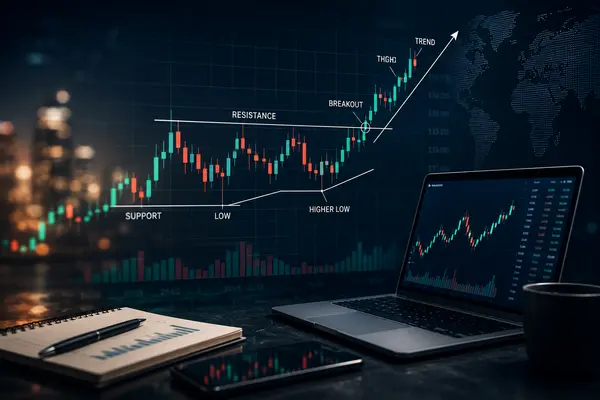
These are just price levels where the market has struggled to move past before. Support is where buyers tend to step in and push price back up. Resistance is where sellers show up and push it back down. Once you start marking these zones on a chart, patterns start jumping out at you that you’d never notice otherwise.
Trends
Markets move in trends — up, down, or sideways — and price action trading is largely about identifying which one you’re in and trading with it, not against it. There’s an old saying that gets repeated for a reason: the trend is your friend. Fighting it usually just costs you money.
Candlestick Patterns
You don’t need to memorize fifty patterns. A handful will get you surprisingly far — things like pin bars (which often signal a rejection at a key level), engulfing candles (which show a strong shift in momentum), and inside bars (which usually mean the market is pausing before its next move). Learn these five or six well, and you’ll spot more opportunities than someone who half-knows fifty of them.
Risk Management: The Part Everyone Skips
Here’s an uncomfortable truth — most new traders lose money not because they can’t read a chart, but because they don’t manage risk. You can have a great strategy and still blow up your account if you’re risking too much on a single trade.
A simple rule that experienced traders swear by: never risk more than 1-2% of your account on a single position. It sounds overly cautious when you’re excited about a “sure thing” setup, but it’s exactly that discipline that keeps you in the game long enough to actually get good.
Always know your stop-loss before you enter a trade, not after. If you’re figuring out where to exit while you’re already losing money, you’ve already made the mistake.
Trading Psychology Matters More Than You Think
Nobody talks about this enough, but your mindset will make or break you long before your strategy does. Price action trading demands patience — you’re waiting for the market to confirm a setup, not chasing every little wiggle on the chart. Traders who can’t sit on their hands tend to overtrade, and overtrading is a fast way to drain an account.
The best price action traders aren’t the ones taking the most trades. They’re the ones taking the right trades, and walking away when nothing’s there.
Getting Started the Right Way
If you’re just beginning, resist the urge to trade with real money right away. Spend time on a demo account first. Mark up charts, practice spotting support and resistance, and watch how price reacts at those levels over and over. Pattern recognition takes repetition — there’s no shortcut around it.
Once you feel like you’re consistently spotting setups before they happen (not after, when it’s obvious in hindsight), that’s usually a good sign you’re ready to size up with small, real positions.
If you want a guided head start instead of piecing it together from scattered videos, check out our practical ebooks and courses in the Trading Academy — built specifically to take you from reading a chart to reading it with confidence.
Frequently Asked Questions
What is price action trading?
Price action trading means making trading decisions based on the raw movement of price on a chart, rather than relying on technical indicators.
Is price action trading good for beginners?
Yes. It focuses on a small set of core concepts — support, resistance, trends, and candlestick patterns — making it easier to learn than indicator-heavy strategies.
Do I need indicators for price action trading?
No. Price action trading is built around reading price and candlestick behavior directly, without indicators.
What candlestick patterns should beginners learn first?
Pin bars, engulfing candles, and inside bars are a good starting point. They’re common, easy to spot, and highly informative.
How much should I risk per trade?
A common guideline is 1-2% of your total account per trade, to protect your capital and stay in the game long term.
Can price action trading be used for crypto and forex?
Yes. Price action principles apply across markets — stocks, forex, crypto, and commodities all show the same underlying buyer/seller behavior on a chart.
How long does it take to learn price action trading?
Most traders need several months of consistent chart practice before they’re comfortable spotting setups in real time. Using a demo account first helps speed this up safely.